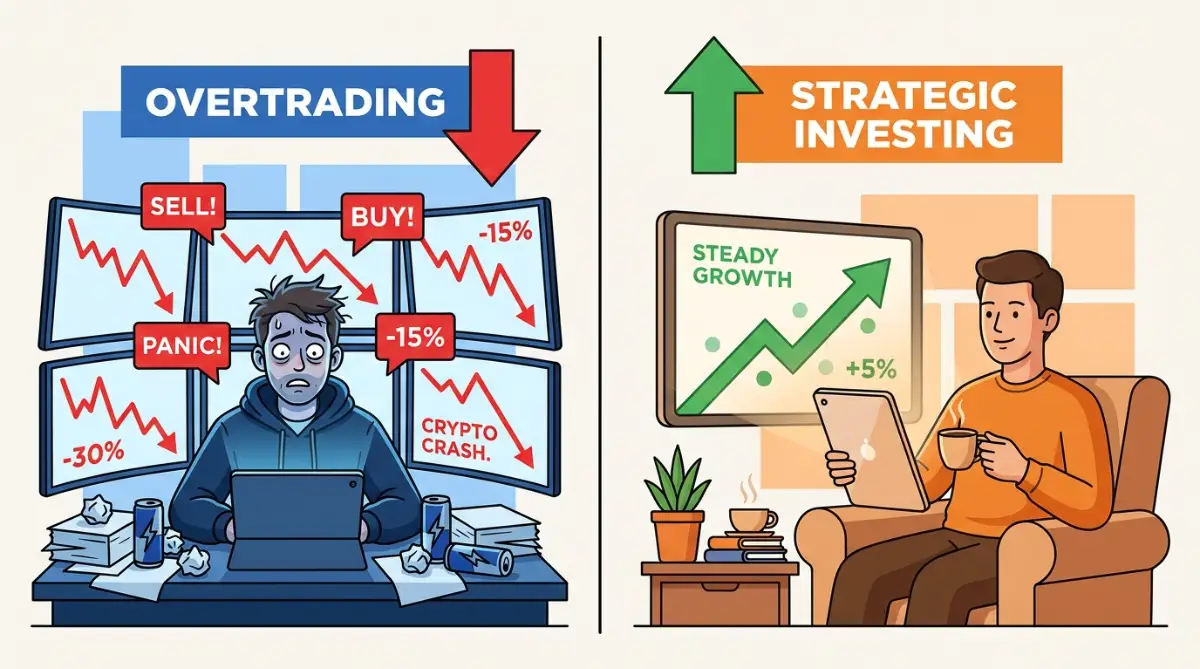
Myth-Busting: Does More Trading Actually Mean More Profit?
Many beginners enter the cryptocurrency market believing that making more trades automatically leads to making more money. It sounds logical at first. If one successful trade generates profit, then ten successful trades should generate even more. Unfortunately, the real world of crypto trading rarely works that way.
This common belief has caused countless traders to lose money, become emotionally exhausted, and abandon their investment goals altogether. Professional traders often follow a completely different philosophy. Instead of chasing every market movement, they focus on patience, discipline, and high-quality opportunities.
Understanding the difference between trading frequently and trading effectively can completely change your approach to the market. This guide explores the reality behind one of the biggest myths in crypto trading and explains how smart decision-making often beats constant activity.
Why This Myth Is So Popular
The cryptocurrency market never sleeps. Prices move every hour of every day, creating the illusion that opportunities are always available.
Several factors reinforce this misconception:
- Social media often highlights massive profits while hiding losses.
- Trading platforms make buying and selling extremely easy.
- Beginners confuse activity with productivity.
- Emotional excitement creates the urge to stay constantly involved.
- Success stories rarely mention years of experience or risk management.
Seeing screenshots of large gains can create unrealistic expectations. What many people never see are the dozens of losing trades that happened before or after those winning moments.
More Trades Do Not Automatically Equal More Profit
The number of trades you make has very little connection to your overall profitability.
Imagine two traders.
Trader A opens twenty positions every week. Some win, many lose, and trading fees slowly reduce overall returns.
Trader B waits patiently for only three or four strong opportunities with clear risk management. Each trade is carefully planned before execution.
At the end of the month, Trader B may earn significantly more despite making far fewer trades.
The goal of trading is not to stay busy.
The goal is to preserve capital while growing it consistently.
Understanding the Hidden Cost of Overtrading
Overtrading is one of the biggest reasons traders struggle to remain profitable.
It occurs when someone enters trades without sufficient reasons simply because they want action or feel they might miss an opportunity.
Common hidden costs include:
Increased Trading Fees
Every transaction carries costs. Frequent buying and selling gradually reduces total returns, especially for smaller accounts.
Emotional Fatigue
Constant decision-making creates mental exhaustion.
Tired traders often become impulsive, ignore their plans, and make avoidable mistakes.
Poor Decision Quality
When traders feel pressured to find opportunities every hour, they often begin seeing patterns that do not actually exist.
This leads to unnecessary risks.
Higher Exposure to Market Noise
Not every price movement matters.
Short-term fluctuations can distract traders from the broader market trend and encourage emotional reactions.
The Psychology Behind Constant Trading
Successful crypto trading is often more about psychology than technical analysis.
Many traders experience emotions such as:
Fear of Missing Out (FOMO)
Watching prices rise without participating can create anxiety.
This fear often causes traders to buy late after a large price increase, increasing risk.
Revenge Trading
After experiencing losses, some traders immediately try to recover their money by opening more positions.
Instead of improving results, this usually increases losses.
Overconfidence
Several profitable trades in a row may convince traders that every decision is correct.
Confidence without discipline often leads to unnecessary risks.
Boredom Trading
Some people trade simply because they feel inactive.
Professional traders understand that waiting is also part of the job.
Sometimes the best decision is making no trade at all.
Quality Always Beats Quantity
Professional traders rarely judge success by the number of trades.
Instead, they evaluate:
- Risk versus reward
- Market conditions
- Trading discipline
- Consistency
- Capital preservation
A single well-planned trade may outperform ten emotional trades.
The market rewards patience far more often than impatience.
How Risk Management Creates Long-Term Success
One of the biggest differences between beginners and experienced traders is their attitude toward risk.
Instead of asking:
"How much can I make?"
Professionals ask:
"How much am I willing to lose if I'm wrong?"
Important risk management principles include:
Use Position Sizing
Never risk a large percentage of your portfolio on a single trade.
Smaller positions help protect capital during losing streaks.
Accept That Losses Are Normal
Even highly successful traders experience losing trades.
Losses become dangerous only when traders refuse to control them.
Follow a Trading Plan
Every trade should have:
- Entry strategy
- Exit strategy
- Risk level
- Profit target
- Stop-loss plan
Random decisions usually produce random results.
Why Patience Is a Competitive Advantage
Financial markets reward patience more than constant action.
Waiting for strong market setups provides several advantages:
- Better entry prices
- Lower emotional stress
- Improved decision quality
- Higher confidence
- Reduced unnecessary losses
Many experienced investors spend far more time observing markets than actually trading.
This may seem boring, but consistency is often built through patience rather than excitement.
Common Misunderstandings About Active Trading
Myth: Professional Traders Trade Every Minute
Reality:
Many professionals spend hours analyzing markets before entering a single position.
Myth: More Screen Time Means More Profit
Reality:
Watching charts continuously often increases emotional reactions rather than improving performance.
Myth: Every Price Movement Must Be Traded
Reality:
Most market movements offer little advantage.
Experienced traders ignore many opportunities because they do not meet strict criteria.
Myth: Fast Decisions Always Win
Reality:
Carefully planned decisions generally produce better long-term outcomes than impulsive actions.
Building Better Trading Habits
Developing healthy habits takes time but significantly improves decision-making.
Helpful practices include:
Keep a Trading Journal
Record every trade, including:
- Why you entered
- Why you exited
- Your emotions
- Lessons learned
Reviewing this information helps identify recurring mistakes.
Create Clear Rules
Define conditions before opening any position.
If those conditions are not present, simply wait.
Focus on Learning
Markets constantly evolve.
Continuous education helps traders adapt instead of relying on outdated assumptions.
Review Performance Regularly
Instead of counting profitable trades, evaluate:
- Risk management
- Discipline
- Emotional control
- Decision quality
These factors often determine long-term success more than short-term profits.

When Trading Less Can Actually Improve Results
Many traders notice significant improvements after reducing unnecessary activity.
Trading less often can lead to:
- Better focus
- Higher confidence
- Reduced stress
- Improved capital protection
- More consistent decision-making
Fewer trades also allow more time for research, strategy refinement, and understanding broader market conditions.
Consistency usually matters more than excitement.
The Difference Between Investing and Trading
Many people mistakenly combine investing and trading into one strategy.
Although both involve cryptocurrencies, they have different objectives.
Trading generally focuses on shorter-term price movements.
Investing typically emphasizes long-term value, research, and patience.
Understanding which approach matches your goals helps prevent unrealistic expectations.
Trying to behave like both an investor and a day trader at the same time often creates confusion.
Practical Questions Before Every Trade
Before entering any position, consider asking yourself:
- Does this trade match my strategy?
- Am I reacting emotionally?
- Is my risk acceptable?
- Do I understand why I'm entering?
- What will make me exit?
- Would I still take this trade if I had already reached my weekly trading limit?
These questions encourage thoughtful decisions rather than emotional reactions.
Developing a Long-Term Mindset
Sustainable success rarely comes from one spectacular trade.
Instead, it comes from hundreds of disciplined decisions made over time.
Experienced market participants understand that preserving capital is often more important than chasing every possible opportunity.
Small consistent improvements usually outperform unpredictable bursts of aggressive trading.
The cryptocurrency market will always create new opportunities.
Missing one trade rarely matters.
Protecting your ability to participate tomorrow matters much more.
Key Takeaways for Smarter Crypto Trading
The belief that more trading automatically creates more profit is one of the most expensive myths in cryptocurrency markets.
Frequent trading increases transaction costs, emotional pressure, and the likelihood of poor decisions. By contrast, disciplined traders focus on quality setups, effective risk management, patience, and continuous learning.
Rather than measuring success by the number of trades placed, evaluate how well each trade aligns with your strategy and long-term financial objectives. A thoughtful approach built on consistency and sound decision-making is far more sustainable than constant market activity.
In crypto trading, the traders who stay patient often achieve stronger results than those who simply stay busy.
How Professional Traders Measure Success Differently
One of the biggest shifts a trader can make is changing how success is measured. Beginners often celebrate the number of profitable trades or the total amount of money earned in a single day. While those metrics may feel rewarding, they rarely tell the complete story.
Professional traders evaluate their performance using a broader perspective. They focus on consistency, disciplined execution, and whether each trade followed a well-defined plan. A profitable trade that breaks every rule is not considered a success because it encourages poor habits. Likewise, a losing trade that followed a solid strategy can still be viewed as a successful decision if the risk was managed correctly.
Instead of asking, "Did I make money today?" experienced traders often ask:
- Did I follow my trading plan?
- Was my risk appropriate?
- Did I avoid emotional decisions?
- Did I learn something valuable from today's market?
These questions create habits that support long-term improvement rather than short-term excitement.
Recognizing High-Quality Trading Opportunities
Not every market movement deserves your attention. One of the most valuable skills in crypto trading is learning how to distinguish between random price fluctuations and genuine trading opportunities.
A high-quality setup often includes multiple supporting factors instead of relying on a single signal.
Examples include:
Strong Market Structure
Price action should show a logical trend or recognizable pattern rather than random volatility.
Confirmed Trading Signals
Avoid making decisions based on one indicator alone. Many experienced traders prefer waiting for several technical or fundamental factors to align before taking action.
Clear Risk-to-Reward Balance
Every trade should offer a realistic opportunity that justifies the amount of capital being risked.
Stable Emotional State
Your mindset matters as much as your analysis. Even a good setup can become a poor decision if it is driven by fear or greed.
The more selective you become, the fewer unnecessary trades you are likely to make.
Why Capital Protection Should Always Come First
Many traders become so focused on earning profits that they forget the first responsibility of investing: protecting existing capital.
Without capital, future opportunities become impossible.
Successful traders understand that preserving funds during difficult market conditions is just as important as growing them during favorable periods.
Practical ways to protect capital include:
- Limiting risk on every position.
- Avoiding impulsive trades after unexpected news.
- Reducing position sizes during highly volatile periods.
- Accepting that sitting in cash can sometimes be the safest strategy.
Capital preservation allows traders to remain active over the long term instead of being forced out after a series of avoidable losses.
Building Emotional Discipline in Volatile Markets
Cryptocurrency markets can move rapidly within short periods, creating intense emotional pressure.
Developing emotional discipline requires practice.
Helpful habits include:
Accept Uncertainty
No strategy guarantees success every time.
Accepting uncertainty reduces the urge to force trades simply to feel in control.
Separate Identity From Trading Results
Winning or losing does not define your abilities as a person.
Viewing each trade as one outcome within a much larger journey encourages balanced decision-making.
Avoid Comparing Yourself With Others
Social media often highlights exceptional wins while ignoring the losses behind them.
Comparing your progress with carefully selected online success stories can create unrealistic expectations.
Focus on your own learning process instead.
The Importance of Having a Repeatable Process
Successful trading depends less on predicting every market move and more on following a repeatable process.
A structured workflow may include:
- Reviewing broader market conditions.
- Identifying potential opportunities.
- Confirming trading criteria.
- Calculating acceptable risk.
- Executing the trade without hesitation.
- Reviewing the outcome after completion.
Following the same process repeatedly creates consistency and reduces emotional decision-making.
Over time, disciplined routines become more valuable than attempting to predict every price movement.
Mistakes That Frequently Reduce Trading Performance
Many trading losses come from preventable habits rather than unpredictable markets.
Ignoring Risk Limits
Increasing position sizes after several losses may seem like a quick recovery strategy, but it often leads to larger setbacks.
Trading Without Preparation
Opening positions without research usually results in emotional decisions.
Preparation creates confidence.
Constantly Changing Strategies
Switching strategies after every losing trade prevents traders from evaluating whether a method actually works over time.
Consistency allows meaningful analysis.
Expecting Every Trade to Be Profitable
No legitimate trading approach wins every time.
Unrealistic expectations often create unnecessary frustration and emotional reactions.
Practical Habits That Encourage Better Decision-Making
Daily routines can significantly improve trading quality.
Consider incorporating these habits:
Read Market News Carefully
Understand important developments without reacting emotionally to every headline.
Schedule Trading Sessions
Rather than monitoring charts continuously, designate specific times for market analysis.
This helps reduce impulsive activity.
Take Regular Breaks
Mental fatigue affects judgment.
Stepping away from charts occasionally allows for clearer thinking.
Continue Learning
Financial markets constantly evolve.
Reading educational materials, reviewing historical charts, and studying trading psychology can improve long-term performance.
Balancing Technical Analysis and Fundamental Research
Some traders rely entirely on charts.
Others focus only on news and economic developments.
Both perspectives provide useful information.
Technical analysis helps identify potential entry and exit points by examining historical price movements.
Fundamental research considers broader factors such as blockchain development, adoption trends, regulatory updates, network activity, and market sentiment.
Combining multiple perspectives often creates more balanced decisions than relying exclusively on one method.
Understanding the Difference Between Activity and Progress
Being busy does not always mean moving forward.
A trader may spend ten hours watching charts without making meaningful improvements.
Another trader may spend one focused hour reviewing previous trades and gain valuable insights that improve future performance.
Progress often comes from deliberate learning rather than constant activity.
Ask yourself regularly:
- Am I improving my decision-making?
- Am I becoming more disciplined?
- Have I reduced emotional mistakes?
- Is my trading process becoming more consistent?
These questions encourage genuine development.
Creating Realistic Expectations for Long-Term Growth
One reason many traders become discouraged is expecting rapid financial success.
Markets rarely reward unrealistic expectations.
Meaningful progress often develops gradually through repeated disciplined actions.
Building experience requires:
- Patience
- Education
- Practice
- Emotional control
- Risk awareness
Viewing trading as a skill rather than a shortcut to wealth creates healthier expectations and more sustainable habits.
Frequently Asked Questions
Does trading every day increase profits?
Not necessarily.
Profitability depends on the quality of trading decisions rather than how often trades are placed.
Many successful traders skip days when suitable opportunities are unavailable.
Is overtrading common among beginners?
Yes.
Many new traders confuse constant activity with productivity, leading to unnecessary risks and higher trading costs.
Should every market movement be traded?
No.
Many price fluctuations do not provide favorable risk-to-reward opportunities.
Patience often produces better outcomes.
Can fewer trades improve performance?
In many cases, yes.
Focusing on carefully selected opportunities can reduce emotional decisions and improve overall consistency.
Why is risk management more important than finding winning trades?
Even excellent trading strategies experience losses.
Risk management helps ensure that individual losses do not significantly damage long-term progress.

Lasting Lessons for Smarter Trading Decisions
The idea that more trading automatically creates more profit may appear convincing, but experience shows that disciplined execution consistently outperforms excessive activity.
Successful cryptocurrency traders understand that every decision should be supported by research, patience, and clearly defined risk management principles. Instead of chasing every market movement, they concentrate on identifying opportunities that genuinely match their strategy.
Building sustainable trading habits requires continuous education, thoughtful self-evaluation, and emotional discipline. Over time, these qualities become far more valuable than simply increasing the number of trades.
Remember that financial markets will continue presenting new opportunities. Missing one trade is rarely as damaging as entering the wrong trade without preparation. By focusing on quality instead of quantity, protecting your capital, and following a structured process, you place yourself in a stronger position to pursue long-term consistency and informed decision-making.
Disclaimer
This article is intended for educational and informational purposes only and should not be considered financial, investment, legal, or tax advice. Cryptocurrency markets involve significant risk, and the value of digital assets can fluctuate substantially. Always conduct your own research, evaluate your financial situation, and consider consulting a qualified financial professional before making investment or trading decisions. Past market performance does not guarantee future results.